
What climbing teaches me about working with teams
I started climbing to switch off. No agenda, no stakeholders, no one asking about the due date. Just me, a rock face, and a very clear problem: get to the top without falling off.
I fall off a lot. And somewhere in that process, I started noticing things that sounded uncomfortably familiar. Here are four of them.
Failure is not the exception. It’s the method.
On rock, you fall. Constantly. You try a sequence, fall, try again, fall differently, try again with less dignity. There are days on the crag where nothing works and you drive home wondering why you do this to yourself. And then, sometimes with no obvious reason, it clicks. The same moves that felt impossible suddenly flow.
I’ll admit: this lesson has limits in the boardroom. When significant budgets or strategic decisions are on the line, “just keep falling until it works” is not a methodology I’d recommend. But the underlying pattern holds: the struggle before the breakthrough is rarely a sign that something is wrong. It’s usually a sign that something is being learned.
Consider: When a team hits a wall, instead of asking “what’s broken?” try “what is this teaching us?” The struggle often carries the signal.
“I can’t do this” is rarely the final answer.
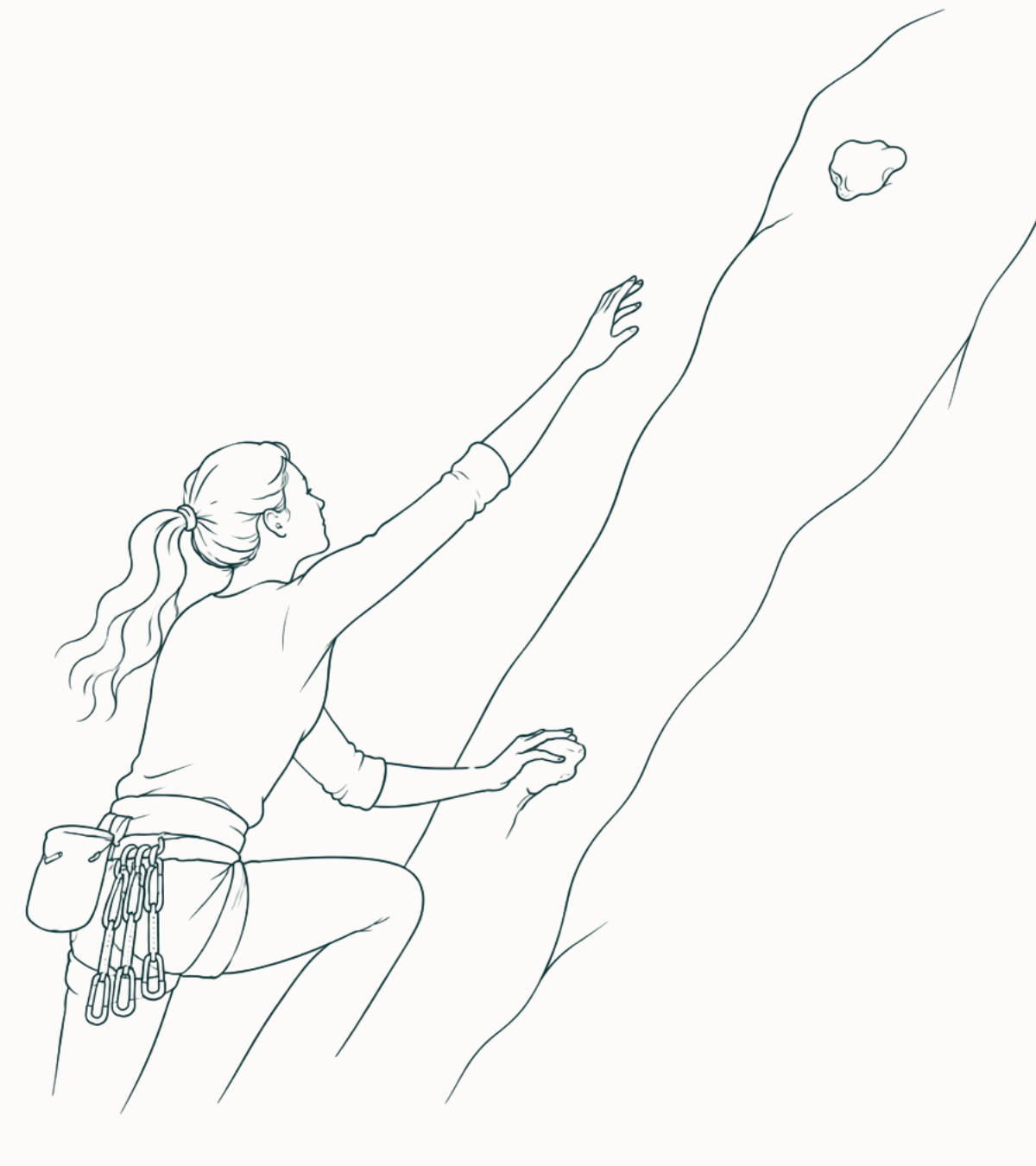
Full disclosure: I’m not tall. This matters more in climbing than you might think. There are routes where the first move is simply not designed for my reach. I’ve stood at the base of a pitch, looked at the opening grip, and thought: I genuinely cannot get there from here. Sometimes I’m right. Mostly, I’m not.
What usually happens is this: my climbing partner says “try it again.” Not with pressure, with curiosity. So I do. And on that second attempt, something shifts. I find a different sequence, a different body position, a workaround that works perfectly for someone my height. The route didn’t change. My relationship to it did.
This is what Carol Dweck describes as a growth mindset. Her research is clear: it's not ability that holds people back. It's the belief that ability can't change. In organisations, I often see teams arrive at “we can’t do this” after a single attempt. The second try rarely gets made, especially if the first one was uncomfortable.
Tip: Build the second attempt into the design. Don’t evaluate a new way of working after one try. And don’t assume there’s only one way to get to the top.
Courage is not the absence of fear.
There’s a moment on every hard route where you can see exactly what you need to do – and you still hesitate. Not because you don’t know the move. Because you’re not sure it will work. The uncertainty is real. The drop below you is real. And waiting for that feeling to pass is, I’ve learned, not a strategy.
What gets me moving is not some surge of bravery. It’s making the next move specific enough that the decision becomes small. Not: “can I climb this route?” But: “can I get to that one grip, right there?” When the step is concrete and close, the courage required shrinks to something manageable.
I see this pattern in organisations navigating uncertainty. Leaders who can see the direction but feel paralysed by everything that’s still unclear. Teams waiting for certainty before they act. The uncertainty won’t resolve itself in advance. But one specific next move, taken today, usually creates more clarity than any amount of planning.
Try this small step: When a team is stuck, don’t ask “how do we get through this?” Ask “what’s the one move we could make today?” That’s all the courage you need – for now.
Trust is not just holding the rope.
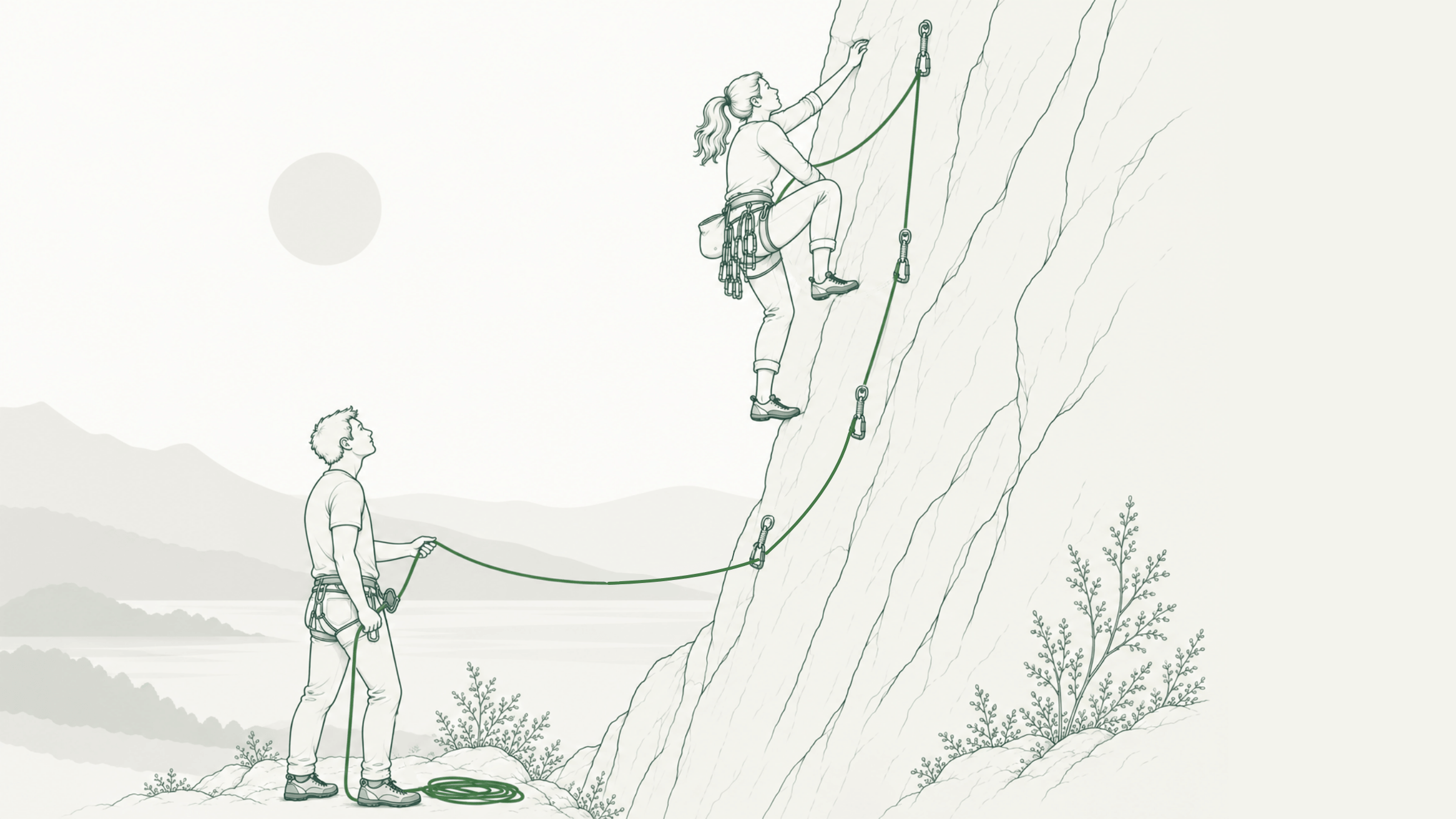
The simplest description of a climbing partner is: the person below who holds the rope. But that description misses almost everything that matters.
A good partner reads you. They know when to give more rope so you can reach for the next grip freely, and when to hold it tighter because you’re close to your limit. They recognise the moment before you’re about to give up – not from what you say, but from how you move. And in that moment, from somewhere below, comes a quiet “Alléz.” Not a command. An offering.
That kind of support only exists in a relationship built on time and trust. It can’t be faked, and it can’t be rushed. This is what Amy Edmondson calls psychological safety: the quiet certainty that you won’t be dropped – literally or figuratively. And what her research shows, consistently, is that safety doesn’t reduce performance. It enables it. When people know the rope is held well, they take risks they wouldn’t otherwise take.
Consider: Who in your team is holding the rope? And do the people climbing actually know it?
Conclusion: the wall as a mirror.
I’m not suggesting you take your leadership team to a climbing wall for a team-building day.
Though I have opinions about that too, as a board member of the alpine school bergpunkt, I might be slightly biased…
Failure as information, not verdict.
The second attempt as the real first try.
Courage as the decision to move, not the absence of fear.
Trust as the rope you don't have to think about.
The best teams I work with have something in common with the best climbing partners I’ve had.
They don’t just hold the rope. They know when to say “Alléz.”